Danieli Automation-Telerobot
5 min read
BOTBLOX SYSTEMS
MISSION
Deliver redundant Ethernet networking inside a miniature inspection robot designed for nuclear fusion facilities, with magnetic field tolerance and halogen-free material compliance.

Danieli Automation-Telerobot
THE COMPANY
Danieli Automation-Telerobot builds remote inspection and intervention robots for hazardous environments. Based in Italy, they develop platforms for nuclear, industrial, and scientific facilities where human access is restricted.


Resume
The Challenge: Redundant Ethernet in a Miniature Robot for Nuclear Fusion Facilities
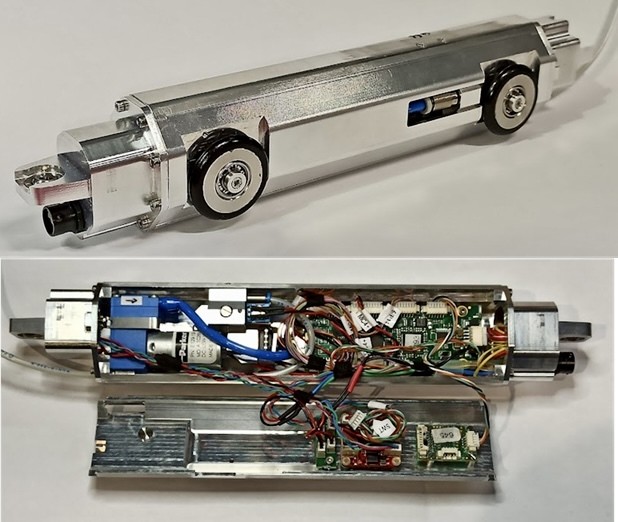
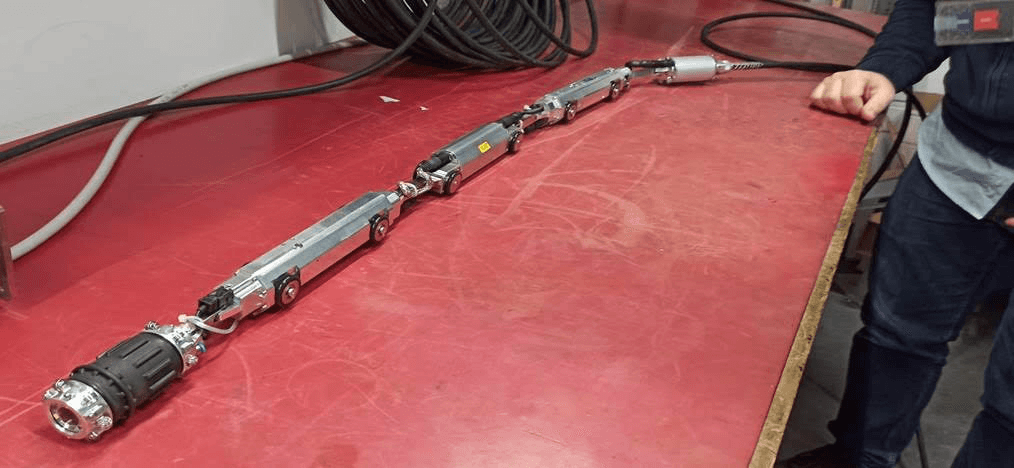
DA_TLR’s inspection robot was designed to operate inside the infrastructure of nuclear fusion facilities, environments that impose uniquely demanding constraints on every electronic component. The robot required redundant Ethernet communication between two onboard devices to ensure reliable data transmission during inspection missions where communication failure could compromise the entire operation.
Three specific constraints made standard networking solutions unsuitable:
Extreme size limitations. The robot’s compact form factor left minimal space for networking hardware. Standard managed Ethernet switches, even those designed for embedded applications, exceeded the available board area. The networking solution needed to fit within a footprint comparable to a coin.
Magnetic field operation. Nuclear fusion facilities generate intense magnetic fields during operation. Electronic components must maintain stable data rates and normal operation under magnetic field exposure. Most commercial Ethernet switches are not tested or validated for performance in magnetic field environments, creating a qualification risk for the project.
Halogen-free component requirements. Nuclear facilities mandate halogen-free materials for all electronic components to prevent the release of toxic gases in the event of fire or overheating. This requirement eliminated many commercial Ethernet switches that use standard halogenated PCB substrates or connector materials.
The combination of these three constraints significantly narrowed the available options. DA_TLR needed an Ethernet switch that was simultaneously the smallest available, validated for magnetic field operation, and manufactured with halogen-free materials.
The Solution: SwitchBlox Nano for Redundant Networking
BotBlox SwitchBlox Nano provided the networking capability DA_TLR required in what is the smallest Ethernet switch available for embedded integration. SwitchBlox Nano delivers three 10/100 Mbps Ethernet ports in a board footprint approximately the size of a quarter coin.
Ultra-compact form factor. SwitchBlox Nano’s minimal board dimensions allowed integration into the robot’s electronics module without requiring redesign of the enclosure or displacement of other subsystems. The switch occupies a fraction of the space that even the next-smallest available alternative would require.
Magnetic field susceptibility testing. BotBlox conducted dedicated magnetic field susceptibility testing on SwitchBlox Nano at DA_TLR’s request. The testing confirmed that the switch maintains stable 100 Mbps data rates under magnetic field exposure at levels representative of the operating environment inside fusion facility infrastructure. This validation provided DA_TLR with the confidence to proceed with integration without additional shielding or mitigation measures.
Halogen-free compatibility. SwitchBlox Nano’s component selection and PCB materials met the halogen-free requirements specified by Fusion for Energy’s procurement standards, allowing the switch to be integrated without material substitution or special exemptions.
Redundant network topology. The three-port configuration enabled DA_TLR to establish a redundant Ethernet link between two onboard devices. If the primary communication path experiences interference or degradation, the second path maintains data continuity without operator intervention.
The Results: Operational Deployment in Fusion for Energy Infrastructure
Successful robot deployment. DA_TLR’s first inspection robot has been deployed and is performing beyond initial expectations. The SwitchBlox Nano provides stable, redundant Ethernet communication during inspection missions inside fusion facility infrastructure.
Magnetic field validation confirmed. The dedicated magnetic field susceptibility testing conducted by BotBlox proved accurate in operational conditions. SwitchBlox Nano maintains full data rates during robot operations without requiring additional electromagnetic shielding.
Production replication planned. Based on the success of the initial robot, DA_TLR plans to incorporate SwitchBlox Nano into additional robot replicas being built for expanded deployment within the Fusion for Energy program.
Funding acknowledgment. This work was funded by Fusion for Energy under Contract F4E-1092, confirming the solution’s qualification for use in one of the world’s most demanding scientific infrastructure programs.
Disclaimer: The work leading to this publication has been funded by Fusion for Energy under Contract F4E-1092. This publication reflects the views only of the author, and Fusion for Energy cannot be held responsible for any use which may be made of the information contained therein.
