Radiation Testing for BotBlox Hardware for Space (LEO, MEO and GEO)
5 min read

Author

Compliance & Testing
Ethernet has become one of the most widely adopted networking standards across industries, and the space sector is no exception. As next-generation satellites push toward lower launch costs, onboard systems must reduce weight and size while maintaining full performance in extreme environments.
BotBlox hardware is already tested to MIL-STD-810H standards for environmental resilience, covering high and low temperature, thermal shock, vibration, mechanical shock, and altitude. But space introduces an additional challenge that ground-based testing alone cannot address: radiation.
This article presents the results of Total Ionizing Dose (TID) radiation testing conducted on two BotBlox embedded Ethernet switches, SwitchBlox Rugged and Puck Mini, with exposure levels up to 20 krad[Si].
Why Radiation Testing Matters for Space Ethernet Hardware
In space, electronics are continuously exposed to radiation from solar flares, galactic cosmic rays, and trapped particles in Earth’s magnetosphere. These radiation sources can cause immediate failures or progressive degradation over time, depending on the type and intensity of exposure.
Radiation testing for space hardware is often considered a complex discipline because of the multiple pathways through which radiation can disrupt or permanently damage electronic components. The four primary test types are:
Total Ionizing Dose (TID)
Total Ionizing Dose measures the cumulative effect of ionizing radiation, typically gamma rays, on electronic components over time. TID is expressed in krad[Si] (kilo-rads of silicon) and represents the total absorbed dose throughout a component’s operational lifetime. It is the standard baseline test for evaluating whether commercial hardware can survive in orbit.
Single Event Upset (SEU)
A Single Event Upset occurs when a single high-energy particle strikes a sensitive node in a digital circuit, causing a recoverable malfunction such as a bit flip in memory or a transient error in logic. SEU events do not cause permanent damage but can disrupt system operation if not properly mitigated.
Single Event Latchup (SEL)
Single Event Latchup is a potentially destructive condition triggered when a high-energy particle activates a parasitic thyristor structure in a CMOS device. Unlike SEU, latchup can cause permanent damage to the component if power is not removed quickly.
Displacement Damage (DD)
Displacement Damage occurs when protons or heavier ions physically displace atoms in the semiconductor crystal lattice. This type of damage accumulates over time and can degrade device performance gradually, leading to increased leakage current or reduced switching speeds.
Together, these four test types build a comprehensive picture of how hardware behaves under the radiation conditions found in Low Earth Orbit (LEO), Medium Earth Orbit (MEO), and Geostationary Earth Orbit (GEO).
BotBlox TID Test Setup and Parameters
Total Ionizing Dose testing was the first step in BotBlox’s space qualification program. TID provides the baseline measurement for determining whether a component can handle the cumulative radiation exposure of a given mission duration and orbit profile.
Radiation Source
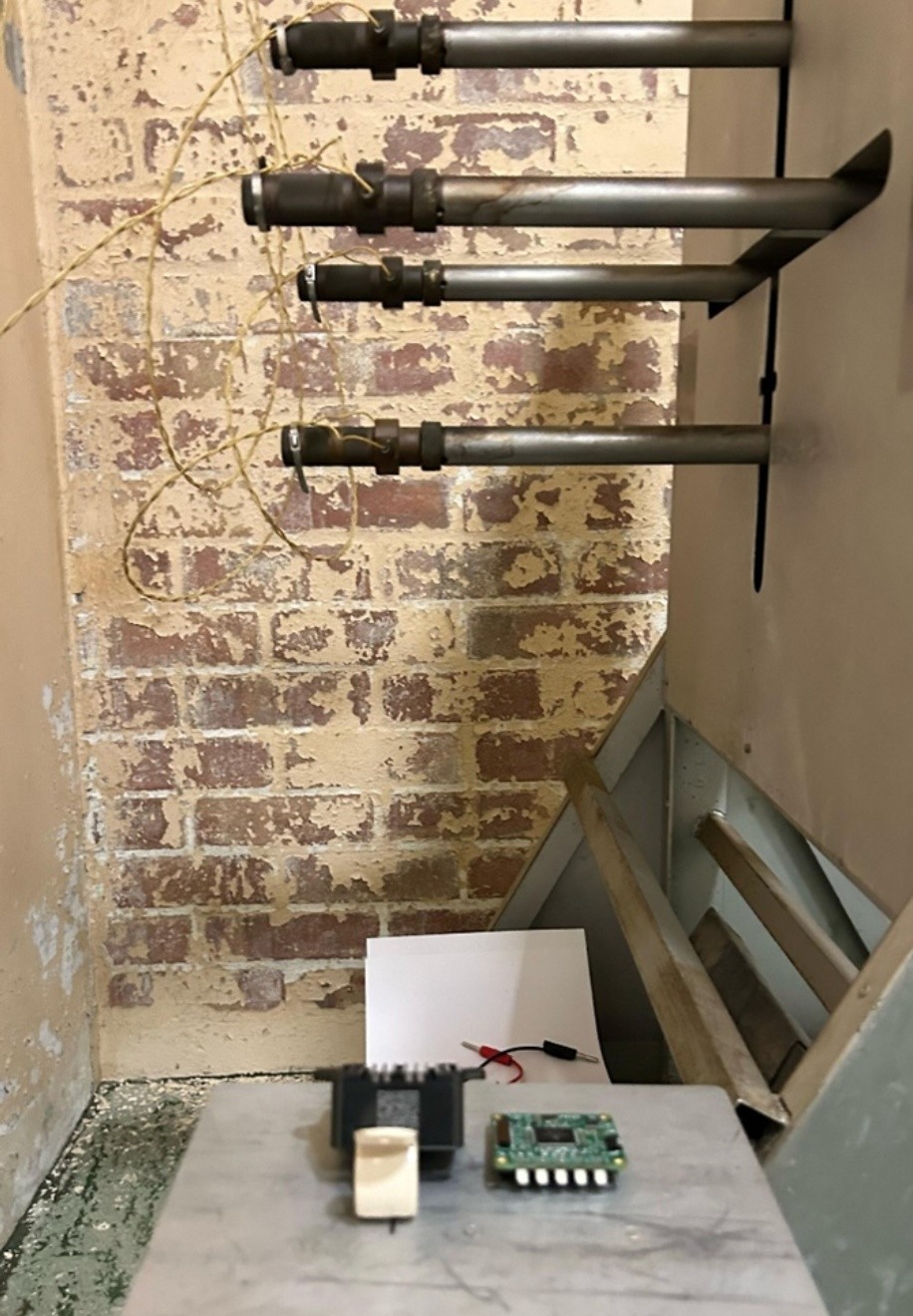
Testing was conducted using a Cobalt-60 gamma ray source, the industry-standard method for simulating the total ionizing radiation environment encountered in space. Cobalt-60 produces a well-characterized gamma spectrum that allows precise dose control and repeatable measurements.

Dose Levels
Devices were tested at incremental dose levels: 1, 5, 7, 10, 12, and 20 krad[Si]. A threshold of 10 krad[Si] is generally considered a strong baseline for non-radiation-hardened commercial hardware. Testing to 20 krad[Si] provides additional margin for longer mission durations and higher orbit profiles.
Products Tested
Two BotBlox embedded Ethernet switches were selected for TID testing:
SwitchBlox Rugged (BB-SWR-G-1): A bare board 5-port 100Mbps unmanaged Ethernet switch designed for harsh environments. Tested without any external shielding.
Puck Mini (BB-PUK-B-1): A sealed, connectorized Ethernet switch with an enclosed aluminium housing that provides approximately 1mm of inherent shielding between the radiation source and the main semiconductors.
Orbital Relevance and Shielding Requirements
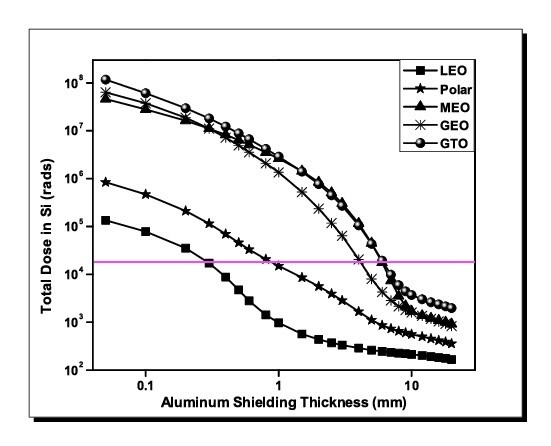
The radiation dose a device encounters in space depends on three factors: orbital altitude, orbital inclination, and the amount of shielding surrounding the component.
The following table summarizes typical annual TID levels for standard orbit profiles:
Orbit | Altitude | Typical Annual TID (behind 1mm Al shielding) |
|---|---|---|
LEO (Low Earth Orbit) | 200 to 2,000 km | 1 to 3 krad/year |
MEO (Medium Earth Orbit) | 2,000 to 35,786 km | 5 to 10 krad/year |
GEO (Geostationary Orbit) | 35,786 km | 3 to 5 krad/year |
At 20 krad[Si] with no measurable degradation, SwitchBlox Rugged is suitable for use in Low Earth Orbit with approximately 0.3mm of aluminium shielding. For Geostationary Orbit, approximately 9mm of aluminium shielding would be required to keep cumulative dose within the tested range over a multi-year mission.
Puck Mini’s enclosed design provides inherent shielding that further extends its effective radiation tolerance in all orbit profiles.
Test Procedure
The TID test followed a three-phase methodology designed to isolate radiation effects from other variables:
Phase 1: Pre-irradiation baseline.
Both devices were powered on and subjected to a full RFC 2544 benchmark at 0 krad[Si] to establish reference performance values for throughput, latency, frame loss, and back-to-back frame handling.
Phase 2: Incremental irradiation.
Devices were powered off and exposed to progressively higher doses of Cobalt-60 gamma radiation at intervals of 1, 5, 7, 10, 12, and 20 krad[Si].
Phase 3: Post-irradiation benchmarking.
After each exposure interval, devices were powered on and subjected to a full RFC 2544 benchmark. Results were compared against the pre-irradiation baseline to detect any performance degradation.
What is RFC 2544?
RFC 2544 is a standardized methodology published by the Internet Engineering Task Force (IETF) for benchmarking the performance of network devices such as Ethernet switches and routers. It measures four key parameters:
Throughput: Maximum data rate the device can forward without frame loss
Latency: Time elapsed between frame ingress and egress
Frame loss: Percentage of frames dropped under load
Back-to-back frames: Maximum burst length the device can handle at full line rate
By comparing RFC 2544 results before and after irradiation at each dose level, any performance degradation attributable to radiation can be precisely quantified.
Test Results
The key finding of this test is that no discernible performance difference was observed in throughput, latency, or packet handling across all tested doses, from 0 to 20 krad[Si].
Both SwitchBlox Rugged and Puck Mini maintained full RFC 2544 compliance at every dose level, demonstrating strong tolerance to cumulative ionizing radiation within the tested range.
SwitchBlox Rugged (BB-SWR-G-1)
Throughput Test
Throughput remained at 100% line rate across all frame sizes at both 0 krad[Si] and 20 krad[Si]. No frame loss was recorded at any dose level.
Latency Test
Latency values remained consistent across all dose levels with no measurable increase between pre-irradiation and post-irradiation measurements.
![SwitchBlox Rugged TID = 0KRad[Si] (No Radiation), Throughput Test](https://framerusercontent.com/images/RiukH32soLcYAkpiT3jdNSriY.jpg)
![SwitchBlox Rugged TID = 20KRad[Si], Throughput Test](https://framerusercontent.com/images/c3qaewRUoG10D1DqNWT3qqTOba0.jpg)
![SwitchBlox Rugged TID = 0KRad[Si] (No Radiation), Latency Test](https://framerusercontent.com/images/uECTWSsNw3SruKOsicU3CdmIBY.jpg)
![SwitchBlox Rugged TID = 20KRad[Si], Latency Test](https://framerusercontent.com/images/gkDn5b7wTLGor2C88EC8Z7waHI.jpg)
Puck Mini (BB-PUK-B-1)
Throughput Test
Throughput performance was identical at 0 krad[Si] and 20 krad[Si], maintaining full line rate across all frame sizes.
Latency Test
Latency measurements showed no variation between baseline and maximum dose exposure, confirming that the radiation did not affect switching performance.
![Puck Mini TID = 0KRad[Si] (No Radiation), Throughput Test](https://framerusercontent.com/images/FYNfsxaPuTJH2UhNtTzLtPmRio.jpg)
![Puck Mini TID = 20KRad[Si], Throughput Test](https://framerusercontent.com/images/zNkMrBAHLptxxTWevvtVyVtbNhM.jpg)
![Puck Mini TID = 0KRad[Si] (No Radiation), Latency Test](https://framerusercontent.com/images/a0lNbbGOUZLVKEEwq7iupzzzMJ0.jpg)
![Puck Mini TID = 20KRad[Si], Latency Test](https://framerusercontent.com/images/Fee140Y0f6VVRL289JbaS6EVxaE.jpg)
Analysis and Limitations
These TID test results demonstrate a promising level of radiation resilience for BotBlox embedded Ethernet hardware in space environments. However, TID alone does not constitute full radiation qualification.
Single Event Effects (SEE), including Single Event Upset (SEU) and Single Event Latchup (SEL), can still compromise system stability or cause permanent failures, particularly in the higher radiation environments of MEO and GEO orbits or during solar particle events.
Additionally, Displacement Damage from proton or heavy ion exposure was not evaluated in this test campaign. DD effects accumulate over time and can degrade semiconductor performance in ways that TID testing does not capture.
Next Steps Toward Full Space Qualification
To achieve comprehensive radiation qualification for space missions, BotBlox plans the following additional test campaigns:
Single Event Effect (SEE) and SEU Testing. Evaluate how single high-energy particles may induce bit flips, transient errors, or latchup conditions in BotBlox switch ICs using heavy ion beam facilities.
Displacement Damage Assessment. Test hardware resilience under proton irradiation to quantify long-term performance degradation from atomic displacement in semiconductor materials.
Long-Duration Life Testing. Conduct extended operation testing at multiple dose rates under conditions that simulate real space radiation profiles over multi-year mission timelines.
Conclusion
Ethernet holds significant potential for space-based networking applications due to its flexibility, broad ecosystem support, and proven network performance. The TID test results presented here confirm that BotBlox SwitchBlox Rugged and Puck Mini can tolerate cumulative ionizing radiation doses up to 20 krad[Si] without measurable performance degradation.
This result is an encouraging milestone in BotBlox’s space qualification program. Combined with existing MIL-STD-810H environmental testing, it positions BotBlox embedded Ethernet switches as viable candidates for networking infrastructure in LEO satellite platforms and other space systems where size, weight, and ruggedness are critical.
Further radiation testing, particularly SEE and displacement damage evaluation, remains essential before full space qualification can be declared. BotBlox is committed to completing these additional test campaigns and sharing the results with the engineering community.
For access to the full TID test report including raw RFC 2544 data at each dose level, contact the BotBlox engineering team at info@botblox.org.
References
MIL-STD-810H: Environmental Engineering Considerations and Laboratory Tests (U.S. Department of Defense)
RFC 2544: Benchmarking Methodology for Network Interconnect Devices (IETF)
Studying the Total Ionizing Dose and Displacement Damage Dose Effects for Various Orbital Trajectories (NASA Technical Reports)