What Happens When You Send an Ethernet Board to Space?
5 min read

Author

Guides & Explainers
Ethernet is pretty straightforward down here on Earth.
You power up a board, plug in a few devices, move some packets around, and assuming you've done your job properly, it keeps doing that for years.
Then you decide to send it to space.
Suddenly, a lot of the assumptions you made when designing that board don't apply anymore. There's no air, temperatures swing dramatically, and you’ve got high-energy particles flying through your electronics. And before the board even gets there, it has to survive being strapped to a rocket and shaken violently on the way up.
As we're learning, making Ethernet work in space isn't just a matter of taking a rugged board and making it more rugged. Space introduces some genuinely strange engineering problems.
Here are four of the big ones.
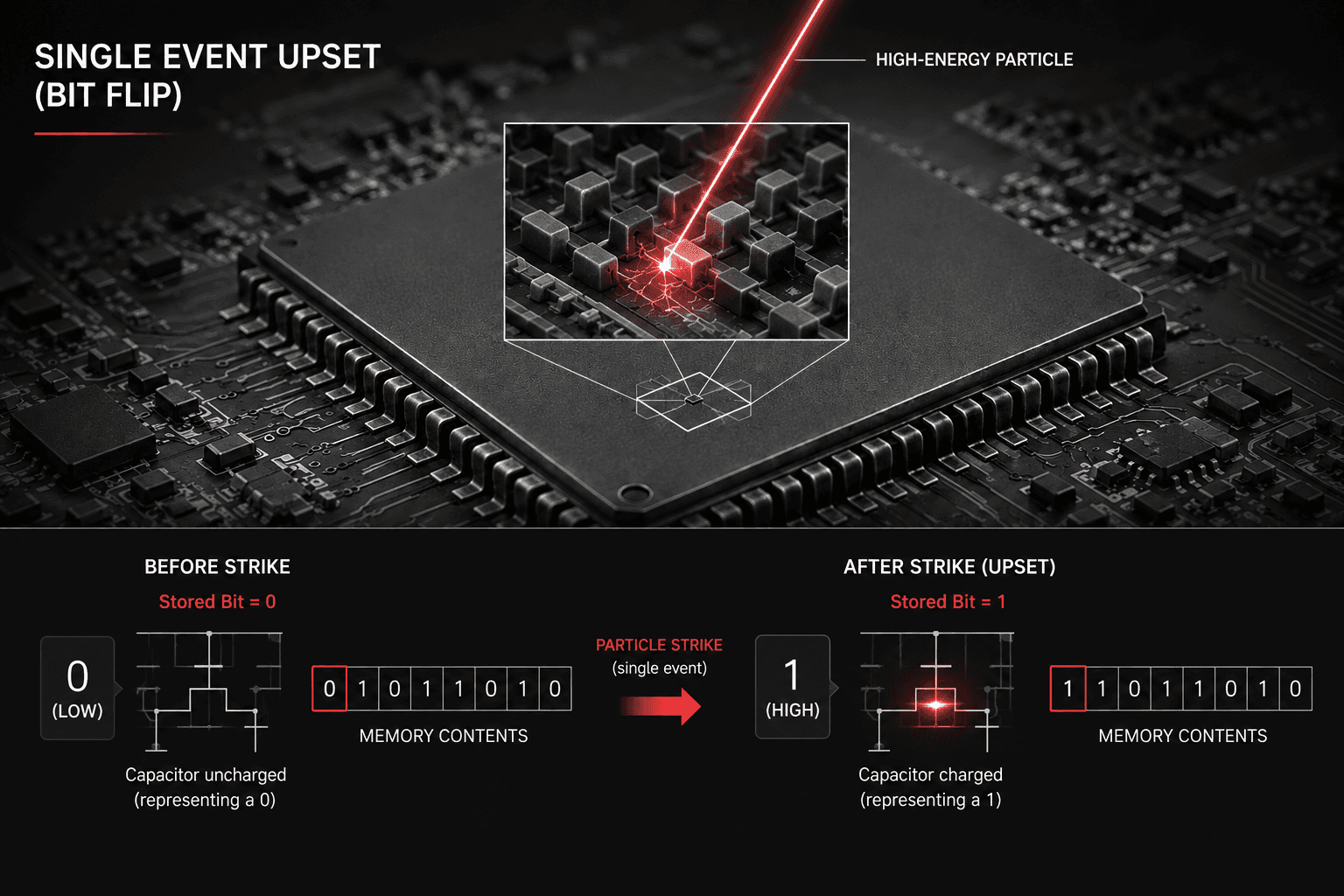
1. A particle flies through your switch and changes a 0 into a 1
Let's start with radiation.
On Earth, we're protected from a lot of high-energy radiation by the atmosphere and Earth's magnetic field. In space, electronics are considerably more exposed. Every once in a while, an energetic particle can pass straight through a semiconductor and deposit enough charge to change its state.
A stored 0 can become a 1. A 1 can become a 0.
This is called a Single Event Upset (SEU), or more casually, a bit flip.
On an Ethernet board, that flipped bit could be sitting in memory, a register, a packet buffer, a configuration setting or a forwarding table. Depending on where it happens, the result could be completely unnoticeable, or your switch could suddenly go haywire.
The interesting thing is that the chip isn't necessarily damaged. It just got hit by a particle at exactly the wrong place and time.
So part of designing for space becomes figuring out not just how to prevent errors, but how to detect them, recover from them and keep operating when they inevitably happen.
And bit flips aren't even the nastiest version of this problem.
A particle can also trigger something called Single Event Latch-Up (SEL). Instead of changing a piece of data, the strike can activate a parasitic structure inside the semiconductor, creating a low-resistance path between the power rails. The current suddenly shoots up. If you catch it, you may be able to shut down that rail and restart the device. If you don't, the resulting current can permanently damage the chip.
So now your Ethernet board may need to be capable of recognizing that one of its own chips is misbehaving and effectively saying: Okay, you're done. Power off. Let's try that again.
2. Even if nothing dramatic happens, radiation is slowly adding up
Radiation doesn't always produce an exciting instantaneous failure, sometimes it just quietly makes your electronics worse.
Over months or years in orbit, semiconductors accumulate what's known as Total Ionizing Dose (TID).
As ionizing radiation passes through semiconductor materials, it creates electron-hole pairs. Some of that charge can become trapped in insulating oxides inside the device. As the dose accumulates, transistor threshold voltages can shift, leakage currents can increase and timing characteristics can change.
Nothing necessarily breaks all at once. The electronics just slowly move further away from the conditions they were designed to operate under, until eventually a component may no longer behave reliably.
Think of it as the difference between getting hit by a baseball and spending five years standing out in the rain. One is an event, the other is exposure.
For an Ethernet board built from commercial components, that's a particularly interesting problem. A PHY, switch ASIC, processor or power supply that has happily spent years running in a robot, aircraft or industrial system hasn't necessarily spent those years being bombarded with radiation.
3. There's no air
This one sounds obvious until you think about what it actually means for electronics.
On Earth, we're constantly using air to cool things. A chip gets hot, it heats the PCB and the air around it, that warm air moves away and cooler air replaces it. Add a heatsink or fan and you can accelerate the process considerably.
In a vacuum, that doesn't happen. There is effectively no air available for convection. Heat still moves through conduction and radiation, but suddenly the thermal path through the board and mechanical structure becomes much more important. Usually, that means deliberately conducting it through the PCB, into an enclosure and eventually into the spacecraft structure, where it can ultimately be rejected through radiation.
For tiny networking hardware, this gets interesting quickly.
Making electronics smaller means packing the same (or greater) power into less space. On Earth, a few watts might not seem particularly dramatic. Put those same few watts into a tiny enclosure in vacuum without a good conductive thermal path and suddenly they matter a lot.
Plus there's the other side of the thermal problem: spacecraft go through repeated heating and cooling cycles. As a spacecraft repeatedly heats and cools, every material on the board expands and contracts. The problem is that they don't all expand by the same amount. The PCB substrate, copper, solder and component packages all have different coefficients of thermal expansion.
The solder joints are stuck in the middle trying to hold everything together.
Cycle that enough times and the repeated mechanical strain can lead to fatigue, microscopic cracks and eventually failed connections. So you're not just trying to keep the board at a safe temperature, you're trying to make sure it can survive being heated and cooled over and over again without slowly pulling itself apart.
4. And then there are the whiskers
This is probably the weirdest hardware reliability problem.
Many electronic components use tin or tin-rich finishes on leads and connector surfaces because tin is conductive, solderable and corrosion-resistant. The problem is that, over time, compressive mechanical stress can build up inside the tin layer.
That stress can come from several places. The tin and the metal underneath it expand at different rates as temperatures change. Intermetallic compounds can also form and grow at the boundary between the tin plating and the underlying copper, physically pushing into the tin layer. Manufacturing and plating
processes can leave residual stresses behind from day one.
The tin wants to relieve that stress somehow.
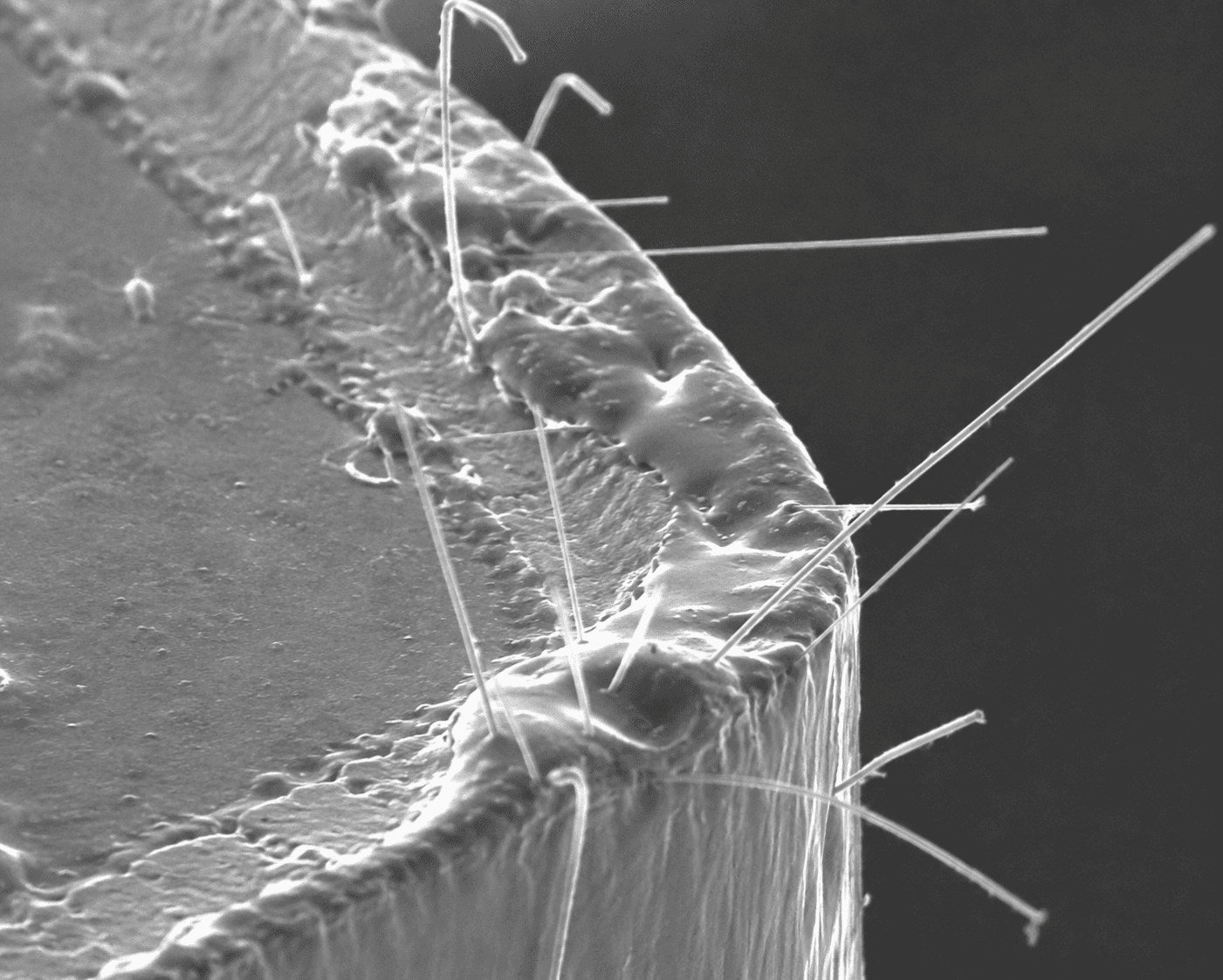
One way it can do that is by transporting tin atoms toward the surface and extruding them outward, gradually forming an extremely thin metallic filament called a tin whisker.
These things can get surprisingly long. A whisker only a few microns wide can grow far enough to bridge two neighboring conductors. Suddenly you have a tiny piece of metal connecting two electrical nodes that were very much not supposed to be connected.
Best case, you get an intermittent fault. Worst case, you get a short circuit.
Space doesn't actually cause tin whiskers, and they can happen in electronics on Earth too. But spacecraft are a particularly unforgiving place for them. Hardware may need to operate reliably for years, it experiences repeated thermal cycling, and if a whisker eventually causes a failure, nobody is going up there with a soldering iron to fix it.
So, how do you make Ethernet work in space?
All this to say: space is a pretty hostile place for a PCB.
A particle can change the contents of your memory. Another can trigger a potentially destructive latch-up. Radiation can slowly change the electrical characteristics of your semiconductors. Your usual cooling mechanisms disappear. Your board repeatedly expands and contracts. And microscopic pieces of tin can decide to start growing out of your components.
And that's before getting into launch vibration, vacuum outgassing, atomic oxygen, spacecraft charging and the long list of other things space hardware has to contend with.
Which, naturally, makes us want to put an Ethernet board up there.
We're now doing testing in space to understand exactly how our hardware behaves in the real environment. There's plenty to learn, but we're on the path to making tiny, rugged Ethernet hardware that doesn't just survive space.
Space is a difficult test.
We're planning on acing it.