As embedded platforms become more complex, they increasingly need sophisticated networking capabilities like VLAN, QoS and Multicast.
As mobile platforms become larger and more autonomous, they become more like a mobile data centers. Current network infrastructure is too large, too bulk and too high power to fit this application.
To solve this, we built a complete firmware and software stack from the ground up, enabling managed networking on boards as small as 38 mm x 38 mm. By fitting traditional network management onto a compact 32-bit microcontroller, we deliver capabilities normally reserved for much larger systems. This means sophisticated network management without any of the Size, Weight or Power.
For your platform, this means :
Sophisticated network management - Tiny size
Achieving complex data flows and network architectures means a mobile system can be far more capable and efficient.
Customizable and extendable
Our OpenWRT based platforms are easily extendable with additional network features, downloadable from the OpenWRT platform.
Actively maintained
Our software is not outsourced, we develop it ourselves in house. This means regular updates, actively maintained and improved.
OTHERs
Buggy software purchased from third party vendor
Legacy software running on high power CPUs.
A single routing solution for all needs.
No customization, fixed features
Old software flashed, bugs and all
WITH BOTBLOX
In-house software, built and maintained by us.
SWaP optimised to run on tiny microcontrollers.
Three tiers covering managed switch to full routing
Actively updated, bugs found and fixed quickly


PRODUCT
BloxOSLite
BloxOS
OpenWRT
Static Firmware
UbiSwitch
✓
—
—
—
Puck Mini
✓
—
—
—
Puck Edge
✓
—
—
—
SwitchBlox Industrial
✓
—
—
—
SwitchCore
—
✓
—
—
DroneNet
—
✓
—
—
Rugged SOM
—
—
✓
—
RouterCore
—
—
✓
—
Puck pro
—
—
✓
—
All other boards
—
—
—
✓
Ethernet's real power lies in the software protocols built on top of it. Here are two of the most common networking requirements we solve on mobile platforms.
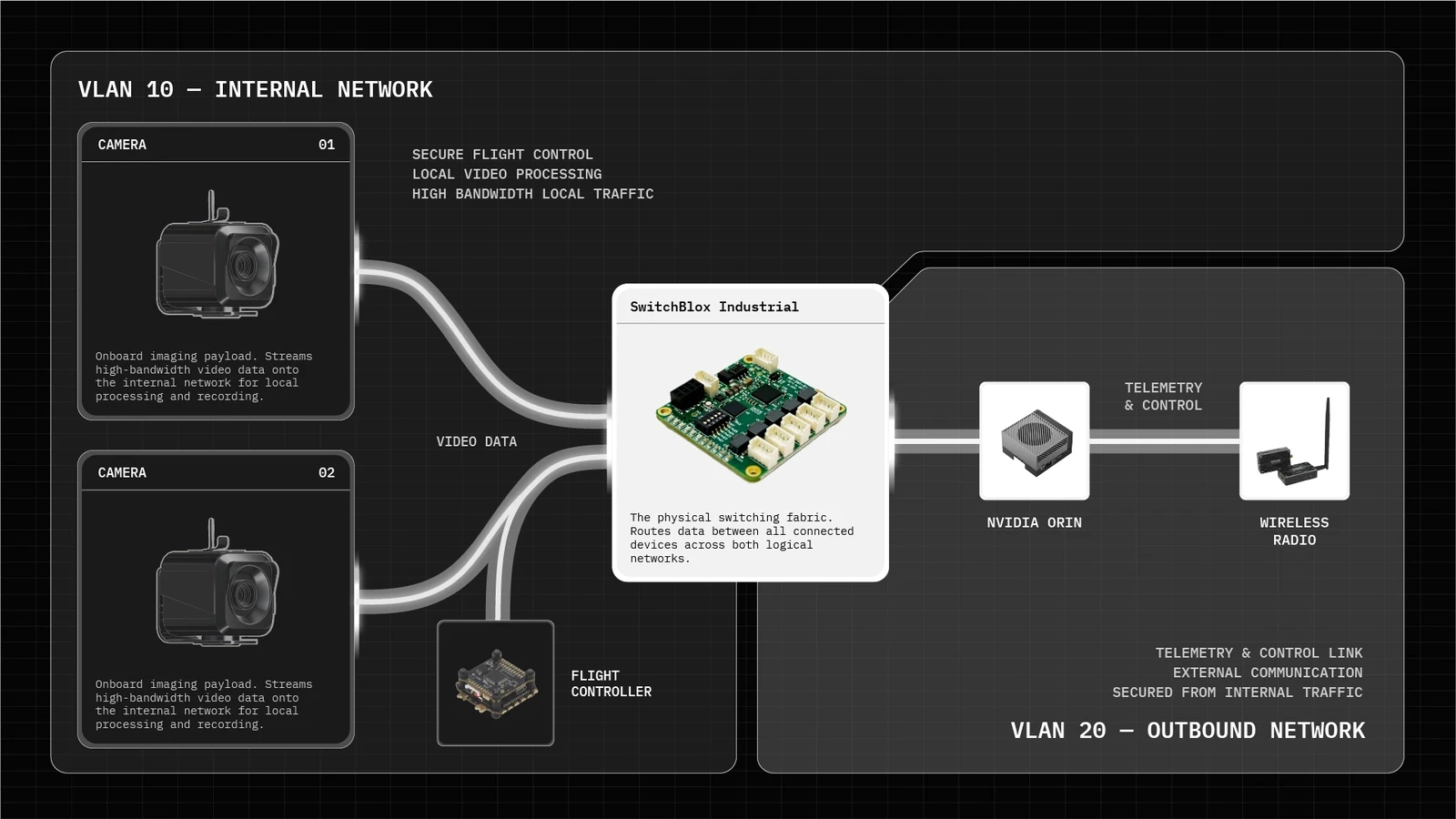
VLAN (IEEE 802.1Q)
Isolate critical systems from external links
LOGICAL NETWORK SEGMENTATION
Split one physical switch into multiple independent networks, by port or by VLAN tag.
INTERNAL / EXTERNAL ISOLATION
Keep cameras, flight controllers, and autopilot on a protected internal network, separated from the wireless uplink.
CONTROLLED TRAFFIC BRIDGING
The single-board computer connects to both VLANs and acts as the only validated gateway between them. External devices cannot reach internal systems directly.
IGMP Multicast
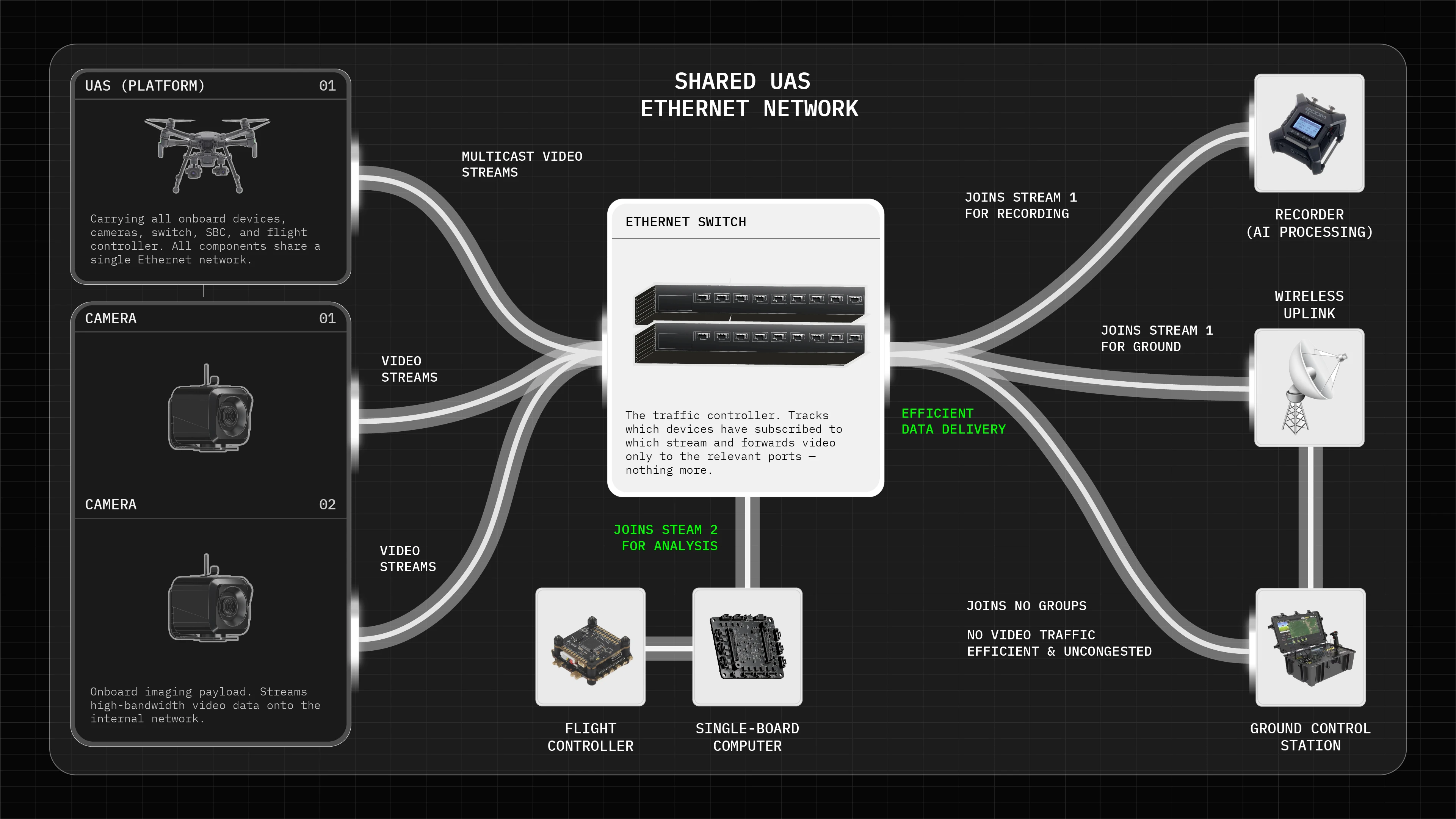
Deliver video only where it's needed
SUBSCRIPTION-BASED VIDEO ROUTING
Each camera stream is assigned to a multicast group. Devices subscribe only to the streams they actually need.
NO BROADCAST FLOODING
Without IGMP management, video traffic hits every port. With it, the switch forwards only to active subscribers.
DYNAMIC STREAM SWITCHING
Devices join and leave groups on the fly — no network reconfiguration needed when the operator switches camera feeds.
CRITICAL TRAFFIC STAYS CLEAR
Control, telemetry, and command messages remain isolated from high-bandwidth video load.
Multi-VLAN, multi-hop, asymmetric topologies for UAVs, underwater vehicles, and industrial systems.
Complex Network Architectures
PTP (IEEE 1588) and NTP implementation for time-sensitive applications requiring synchronised data streams.
Ethernet Timing Protocols
Hard real-time firmware on microcontrollers where no OS overhead is acceptable.
RTOS & Bare Metal Development
OpenWRT, pfSense, OpenBSD — custom-built and stripped for the target hardware and use case.
Custom OS Development
Yocto-based distributions tailored to embedded networking platforms with minimal footprint.
Embedded Linux
Assembly-level code and compiler optimisation for memory-limited, power-constrained devices.
Low-Level Optimisation
Common questions about BotBlox software
What software do BotBlox switches run?
BotBlox products use different software levels depending on the hardware complexity and the networking features required — BloxOSLite, BloxOS, OpenWRT and Static Firmware — covering everything from lightweight Layer 2 switch management to full routing functionality.
Which software level do I need?
For simple Layer 2 management (VLANs, port control, link aggregation), BloxOSLite is the right choice, which uses a CLI. For Layer 3 routing with full and easy customisation via a GUI, OpenWRT is best. BloxOS provides Layer 3 routing using just a microcontroller instead of a full microprocessor. BloxOS is a middle ground between BloxOS Lite and OpenWRT, providing Layer 3 routing in an ultra small SWaP package.
What is BloxOSLite?
A highly optimised CLI for 32-bit microcontrollers. It provides Layer 2 switch management — VLANs, link aggregation, port configuration — without requiring a full CPU and RAM-based Linux system.
What is BloxOS?
A lightweight Linux-based OS built with Yocto. It provides full routing functionality in a compact, customisable base distribution for embedded networking applications. It is less extensible and less easy to use than OpenWRT, but it requires far less power and size to be achieved.
What is OpenWRT?
OpenWrt is an open-source, Linux-based operating system designed for routers and embedded devices. Unlike restrictive, stock router firmware, it provides a fully writable file system and a package manager, allowing you to install advanced network tools, improve security, and customize your hardware. It is highly capable but requires a full CPU with RAM, giving the hardware a higher SWaP profile.
What is the difference between BloxOS and OpenWRT?
BloxOS is a lean Yocto distribution we built to achieve Layer 3 routing on incredibly small and low power hardware. OpenWRT provides a more complete out-of-the-box environment including a GUI and CLI, but with more software overhead. OpenWRT is far more easy to configure, and has a familiar GUI, whereas BloxOS can only be extended by us (BotBlox), and only has a command line.
Why not use OpenWRT on every product?
Many applications only require Layer 2 switch management. Setting VLANs for example are a hugely common need for mobile platforms, and don't require a full-on layer 3 router to achieve. Running OpenWRT in those cases would require more hardware resources than the application justifies, adding unnecessary size, weight, power, and cost. We built BloxOSLite to achieve basic layer 2 management features while only adding around 70mm² of board area and less than 50 mW of power consumption.
What's wrong with the existing switch management software running on other embedded switches?
Well firstly, the hardware this software runs on is bulky and power hungry, which rules out this option for compact next generation systems. The existing routing software running on some board level ethernet hardware is old, unmaintained, and not developed by the people building the hardware. This makes it buggy, flakey, and generally not rugged. Our software is built by us, maintained often, and tailored specifically to the hardware we build.
Does BloxOSLite support VLANs?
Yes. BloxOSLite supports VLAN configuration, along with other Layer 2 features including port control and link aggregation.
Does BotBlox software support routing?
Yes — on products running BloxOS or OpenWRT. BloxOSLite is focused on Layer 2 switch management and cannot achieve any Layer 3 functionality such as routing.
Can customers customise the software?
OpenWRT can be customised and extended easily by downloading additional packages to add more functionality. BloxOS and BloxOSLite are not designed for direct customisation by the customer. This is a tradeoff of the software being lightweight and able to run on a low power microcontroller.
How is the software configured?
Configuration depends on the product. BloxOSLite is accessible via a CLI over a TTL serial port. BloxOS is a CLI running via an ethernet port. OpenWRT is accessible via a CLI and GUI via an ethernet port.
Why does BotBlox offer three software levels?
Embedded systems have fundamentally different networking requirements. Offering three levels allows each product to carry exactly the capability it needs — without unnecessary hardware or software overhead.
Can BotBlox develop custom firmware for specific requirements?
Yes. For applications with complex or unique network topologies, we develop custom firmware and software to specification. Get in touch to discuss your requirements.
